Private Home Cinema in a Dubai Villa: Design and Installation Guide
Glass walls, marble floors and air conditioning that never sleeps. A Dubai villa asks different questions of a cinema room, and the answers start long before the projector arrives.
It is 40 degrees outside and the villa hums with cooling. You step through a heavy door, it seals behind you, and the hum is simply gone. The screen wakes, the room darkens to true black, and a helicopter crosses from the back wall to the front so precisely that you look up without meaning to.
A private home cinema in Dubai can feel like that, but a villa here is not a neutral box. Glass, stone, double-height spaces and year-round air conditioning shape every decision. This guide covers what changes in Dubai, how to choose the room, and when the cinema team should join the project.
What makes a Dubai villa different
Most villas in Dubai, Palm Jumeirah and Emirates Hills are designed around light and openness. That is the opposite of what a cinema needs.
Glass and hard finishes
Floor-to-ceiling glazing, marble and polished plaster reflect sound like mirrors reflect light. Dialogue blurs, bass booms in one seat and vanishes in the next. In a dedicated room the answer is an enclosed shell with acoustic treatment. In an open living area it is integration: drapery, rugs, absorptive panels hidden in joinery and calibration for the room that remains.
Cooling that never stops
Air conditioning in a Dubai villa runs most of the year. In a cinema it has to remove the heat of guests and equipment while staying below the threshold of hearing. That means duct routes designed with the room, low air velocity at the grilles, silencers and a projector in a ventilated hush box. Noise from cooling is the most common complaint in cinemas that were added late.
Open plans and double heights
Grand majlis spaces and double-height living rooms are wonderful for guests and difficult for sound. Volume is not the problem; the lack of a closed boundary is. These spaces suit a living room cinema or a media room far better than a reference-level installation.
Choosing the room
The best cinema room in a villa is rarely the most impressive one on the floor plan. It is the one that can be closed, isolated and cooled quietly.
Good candidates for a dedicated room include a basement where the villa has one, an interior room on the ground floor with no glazing, or a guest wing room away from bedrooms. Size matters less than shape: a rectangular room with a ceiling of at least 2.6 m leaves space for a riser, height channels and a large screen. We have built a full Dolby Atmos 7.1.4 cinema in 29 m² under a 2.58 m ceiling, so a modest room is not a reason to give up.
When the cinema team should join
Timing decides cost and quality more than any piece of equipment. The earlier the cinema is designed, the more of it disappears into the structure of the villa.
For a room of about 40 m² the whole path takes 9 to 12 months. If the villa is already finished, the cinema is still possible, but every hidden route has to be found or created, and the design has to respect what is already built.
We would rather say no than build a room that cannot deliver. If a space cannot be isolated or cooled quietly, we recommend a media room or a living room cinema there, and design it to the physical maximum of that room.
Two Dubai private home cinemas
Cavalli Estates Dubai — CEDIA Awards Winner 2026
A private home cinema for a villa in Dubai, designed down to the last port before anyone could step into the room. The project was documented in a 140-sheet Revit set and won Excellence in Documentation at the CEDIA Awards 2026.
- Room
- 30 m², 7 seats
- Sound
- Dolby Atmos 9.1.6 on Alcons Audio, behind removable acoustically transparent panels
- Bass
- 8 subwoofers for Trinnov WaveForming
- Image
- 145" screen, JVC DLA-NZ900 in a ventilated, sound-isolated hush box
- Documentation
- 140-sheet project set in Revit
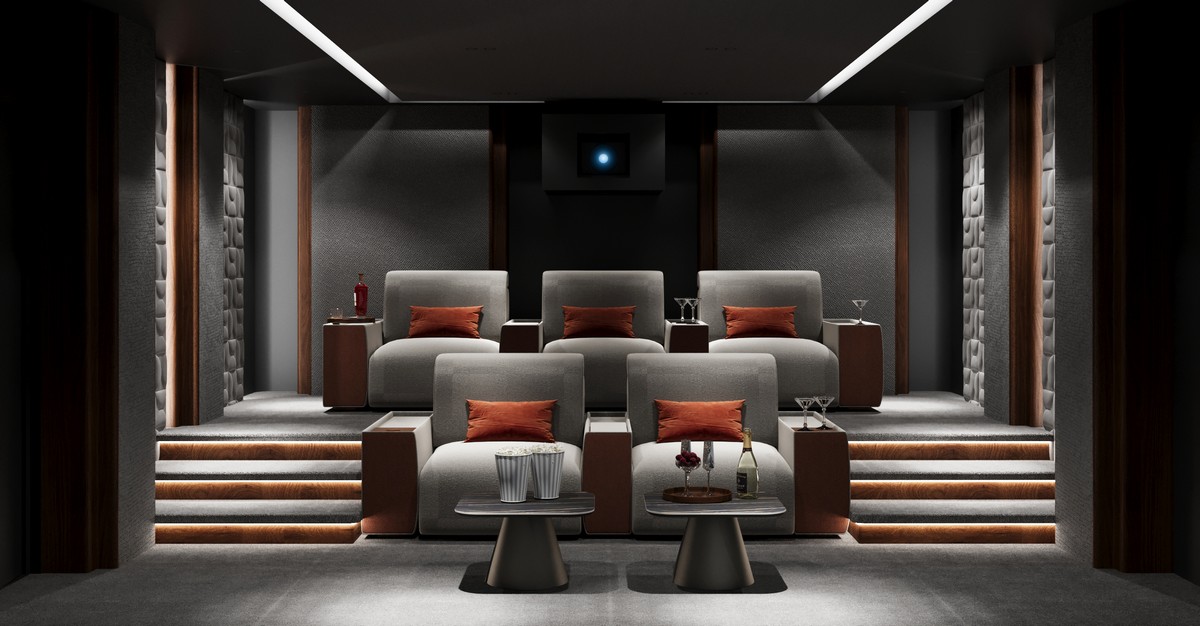
Cavalli Estates Dubai
Jumeirah, Dubai
A larger family cinema in Jumeirah with seats for eleven guests and a 170" screen. Here the challenge was scale: a full Dolby Atmos 9.1.6 layout and a seating plan that keeps every row inside the reference zone.
- Room
- 52 m², 11 seats
- Sound
- Dolby Atmos 9.1.6
- Image
- 170" screen

Jumeirah, Dubai
Questions to ask any installer in the UAE
- Will you visit the villa and measure the room before quoting?
- Who designs the isolation and the cooling, and who is responsible if the room is noisy?
- Will I receive a full design set before construction, and who supervises the trades on site?
- Which performance level will the room reach, and how will you prove it after calibration?
- Can the system be upgraded later without opening walls?
Clear answers to these five questions say more about the final room than any equipment list. If you are planning around a budget, our guide on what drives private home cinema cost in Dubai explains where the money goes.
Frequently asked questions
Which room in a Dubai villa is best for a private home cinema?
A room that can be fully closed, has no large glazing and sits away from bedrooms: a basement if there is one, an interior ground-floor room or a guest wing room. Rectangular rooms with a ceiling of about 2.6 m or more are easiest to work with.
Can you install a cinema room in a finished villa?
Yes. It takes more work to find routes for ducts and cables, and some isolation may have to be built inside the existing room. A site visit shows what is realistic before any design starts.
How do you keep air conditioning silent in a cinema room?
By designing the ducts together with the room: low air velocity at the grilles, silencers, decoupled connections through the isolated shell and a projector in its own ventilated hush box. Cooling is part of the acoustic design, not an afterthought.
How long does home cinema installation in Dubai take?
For a private home cinema of about 40 m², typically 9 to 12 months from the first drawing to final calibration. Installation of the systems takes two to three weeks of that time.
Do you work with our architect and interior designer?
Always. We design in Revit and work to RIBA and AIA protocols, so our drawings fit into the architect's set. The interior design stays the designer's; technology either disappears into it or becomes a deliberate accent.
Can I experience a Blackroom cinema in Dubai before deciding?
Yes. We invite clients to a private demonstration in Dubai, where you can hear and see what a calibrated private home cinema does. Contact us to arrange a time.