Trinnov Calibration and Room Acoustics: How to Get 100% From High-End Speakers
The most expensive speakers in the world can sound like a pile of metal in a bare room of concrete and glass. Here is how room acoustics and Trinnov calibration turn them back into an instrument.
Picture a room with panoramic glass and polished concrete, and a flagship speaker system worth more than a car. The first explosion on screen arrives as a smear: echo, boom, a rattle somewhere in the ceiling. The owner turns the volume down, and the magic goes with it.
Now picture a modest, carefully chosen system in a room designed for it. The bass lands and stops. Voices sit exactly on the actors' lips. After two hours your ears are not tired. In private home cinemas this is the rule, not the exception: the room decides how the speakers sound.
The high-end paradox: the room decides
Every speaker plays into a room, and the room answers back. Bare walls, glass and stone return the sound as reflections that arrive milliseconds later and blur the original. Low frequencies bounce between parallel surfaces and pile up into standing waves: in one seat the bass booms, two meters away it disappears.
A Steinway in a gym sounds worse than an upright piano in a concert hall. Speakers obey the same physics. Well-chosen speakers in an acoustically prepared room sound cleaner, deeper and easier on the brain than a far more expensive system in an untreated space.
Full immersion comes from three elements working together:
- Sound isolation keeps the film in and the house out.
- Passive acoustic treatment shapes how sound behaves inside the room.
- Electronic calibration with a processor such as Trinnov tunes every channel to the room that remains.
Skip one, and the other two can't make up for it.
Acoustic treatment: preparing the room
Isolation is not treatment
The two are often confused. Isolation is construction: a floating floor, heavy acoustic doors, a ceiling on vibration-isolating hangers — the room-within-a-room shell. Treatment works inside that shell. It decides how each sound wave is absorbed, scattered or reflected before it reaches your ears.
The danger of over-damping
Covering every wall in mineral wool or foam without calculation creates the opposite problem. Reverberation collapses, and the room turns into a pressing silence where you can almost hear your own pulse. Voices sound lifeless, and after a few minutes people want to leave.
Why thin foam and felt don't work
One or two centimeters of foam, or decorative felt with wooden slats, behave like a low-pass filter. They absorb the highs and leave the boom of the bass and the clutter of the midrange untouched. The room ends up muffled and boomy at the same time.
A 1–2 cm panel controls treble only. Taming bass and midrange takes depth, density and calculated placement.
What professional rooms use instead
Professional theaters combine dense absorption with diffusion. For absorption we use boards of compressed recycled cotton, which shed no microparticles for guests to breathe. Hybrid and 3D diffusers scatter sound instead of absorbing it, so a small room keeps its energy and sounds larger. Blackroom makes absorbing, diffusing and hybrid panels in-house and hides them, together with the speakers, behind acoustically transparent fabric walls.
The target: RT60 of 0.25–0.4 seconds
RT60 is the time it takes sound to decay by 60 dB after the source stops. For a small room used for film and music, the comfortable range is 0.25–0.4 seconds. Shorter, and the room feels dead. Longer, and dialogue loses clarity while the bass hangs in the air after every hit.
Why Trinnov: the electronic link
Standard AV receivers with automatic room correction were built for living rooms with five speakers. In a complex small room with a dozen or more channels, they run out of processing power and flexibility. Trinnov Altitude 16 and Altitude 32 processors work in professional studios and commercial cinemas for the opposite reason: a large computing reserve and the ability to tune every channel on its own.
The 3D microphone
Trinnov calibration starts with a measurement by a multi-capsule 3D microphone. It captures not only each speaker's frequency response but its physical position in the room — distance, azimuth and elevation — along with its phase and impulse response. The Optimizer then corrects how each speaker interacts with the room, in both frequency and time.
A clean digital path
With Audio over IP (Dante or AES67), the signal travels from the Trinnov processor to the amplifiers over a standard network cable, without extra digital-to-analog conversions along the way.
WaveForming: bass that stops when the film says stop
In a small room, bass reflects off the back wall and meets itself on the way back. The result is standing waves: deep dips at some frequencies, humps at others, and a low drone that keeps sounding after the explosion on screen has ended.
Trinnov WaveForming deals with the cause rather than the symptom. An array of subwoofers at the front of the room launches an even, flat wavefront. Subwoofers at the back work in antiphase and cancel that wave as it arrives, so it never reflects back into the room.
You hear the difference within seconds. Bass becomes fast, dense and punchy. A kick drum hits your chest and stops. A depth charge in a submarine film comes up through the seat, and the silence after it is real silence.
Calibration in practice
Dealing with SBIR
When a speaker stands away from the front wall, part of its output reflects off that wall and returns in antiphase. At a certain frequency the two cancel, and a dip appears that no equalizer can fill. This is SBIR, speaker boundary interference response. There are two solutions: raise the subwoofer crossover so the speaker no longer plays the affected range, or build the front speakers into a rigid baffle wall so there is no gap to reflect from.
Building the target curve
A perfectly flat frequency response looks ideal on a graph and sounds dry and unpleasant in a room. In practice, calibration starts with a gentle lift of the bass by 3–6 dB below about 150 Hz and a smooth roll-off of the highs above 1–2 kHz.
Warm-up before measuring
A freshly installed system is never calibrated straight away. Speakers need several dozen hours of playing for their suspensions to settle into working condition. On calibration day, laser projectors and amplifiers warm up for 30–40 minutes before any measurement is taken.
The final test is a familiar film
Measurements set the direction; ears confirm the result. The last pass is done on music and film scenes the specialist knows by heart. When calibration is right, the speakers vanish. A plane flies in from behind, a helicopter crosses the ceiling, footsteps move across the room — and nobody in the seats can point to where the sound came from. Heads turn on their own.
In Blackroom projects, final audio and video calibration takes 3–4 days and is done by hand by a Trinnov-certified engineer, alongside ISF and HAA calibration. In Stingray, a Trinnov Altitude16 drives Alcons speakers and eight 15-inch subwoofers that reach down to 12 Hz — a frequency you feel in your chest rather than hear.
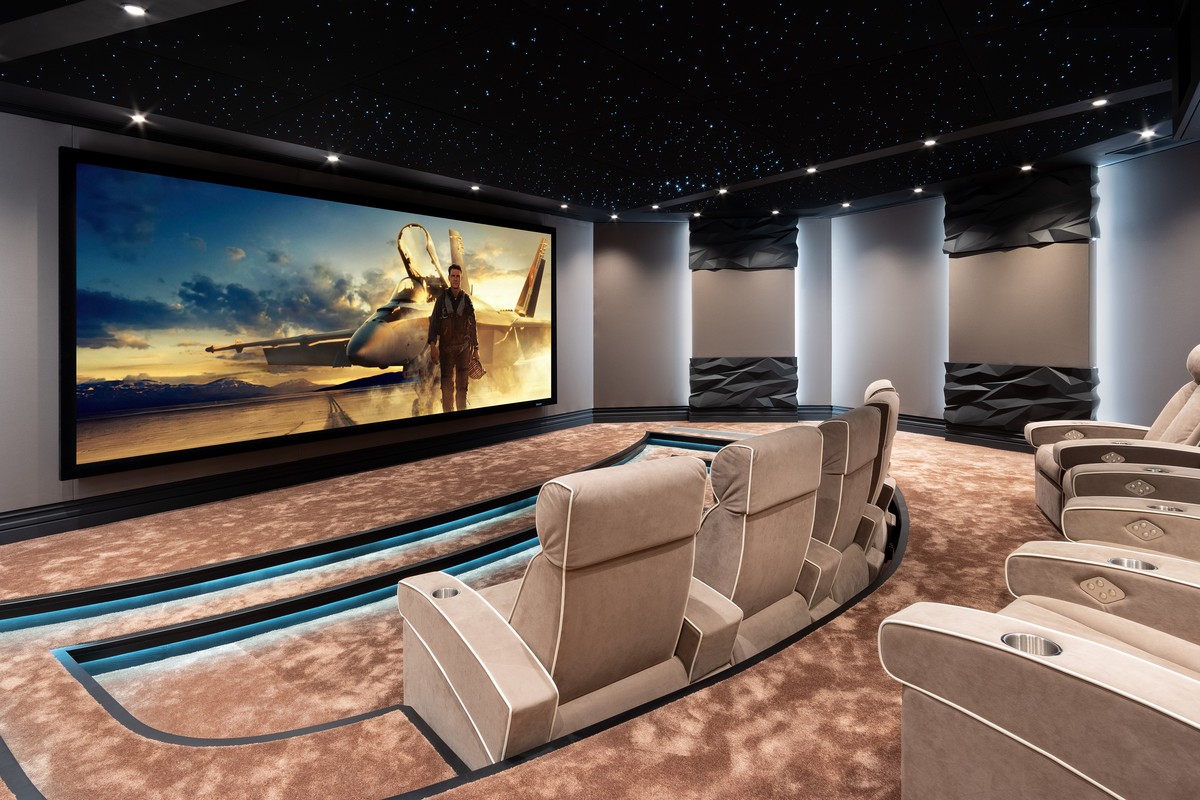
Stingray
Installer checklist
Frequently asked questions
Does room correction replace acoustic treatment?
No. Room correction adjusts what the speakers send into the room; treatment changes how the room responds. A processor cannot remove long reverberation or strong reflections. Treat the room first, then calibrate.
What is a good RT60 for a home theater?
About 0.25–0.4 seconds in a small room: short enough for clear dialogue and tight bass, long enough to keep the room from feeling dead.
Is acoustic foam good for a home theater?
Thin foam of 1–2 cm absorbs only high frequencies. It dulls the treble without controlling bass or midrange. Dense, deep absorbers and diffusers work far better.
What is Trinnov WaveForming?
A Trinnov technology that uses subwoofer arrays at the front and back of the room. The front array creates an even wavefront; the rear array cancels it in antiphase, so standing waves never form and bass stops instantly.
How long does professional calibration take?
In Blackroom projects, final audio and video calibration takes 3–4 days.
What target curve should I use?
Not a flat one. A typical starting point is a 3–6 dB bass lift below about 150 Hz and a smooth roll-off above 1–2 kHz, refined by ear on familiar content.
Default Rich Text Content
Default Rich Text Content
Default Rich Text Content
Default Rich Text Content
Engineered for goosebumps
The price of a speaker sets its potential. The room and the calibration decide how much of it you will ever hear. That is why Blackroom designs, builds and calibrates private home cinemas and media rooms as one system: isolation, acoustics, equipment and tuning in one project. 60+ projects, 6× CEDIA Awards Winner, 2023–2026.