What Speakers Do Cinemas Use, and What a Private Home Cinema Should Borrow
Behind every cinema screen stands a wall of speakers built for one job: playing a film at the level it was mixed, for hours, without strain. Some of that thinking belongs at home. Some of it does not.
The opening logo fades, and the first explosion of the trailer hits the whole auditorium at once. Not loud in the painful sense: big, clean, physical. Your seat moves a little. Three hundred people around you feel the same thing at the same moment. That effortlessness is not an accident of volume. It is the result of speakers designed to play at reference level all day, every day.
Owners of private home cinemas often ask whether they should simply install what cinemas use. The answer is partly yes. The principles behind cinema loudspeakers are exactly right for a dedicated room. The hardware itself was built for a space many times larger than yours.
Behind the screen of a commercial cinema
In a commercial auditorium the left, center and right channels stand behind a perforated screen, usually as large horn-loaded systems with big woofers. Horns concentrate sound toward the audience and deliver high sensitivity, so a modest amplifier produces very high levels with little distortion. Subwoofers sit at the base of the screen wall. Along the side and rear walls hang arrays of surround speakers, and in immersive formats more speakers are mounted overhead.
Everything is designed around a single goal: the same experience in the front row and the last one, at the level the film was mixed.
Reference level: the numbers behind cinema sound
Films are mixed and played to a defined reference. A test signal at −20 dB below full scale produces 85 dB at the listening position from each screen channel. That leaves 20 dB of headroom, so every channel must be able to reach 105 dB peaks. The low-frequency effects channel is mixed 10 dB hotter and must reach 115 dB.
A speaker that compresses or distorts at these peaks turns the climax of the film into noise. That is why cinema loudspeakers are rated by how much clean output they deliver, not by how they sound at background volume. The CEDIA/CTA-RP22 standard uses the same logic for private rooms: Level 3 asks for 105 dB peaks at the seats, Level 4 for 108 dB.
Mixing stages: where the film is finished
The most interesting speakers are not in the multiplex but in the rooms where films are finished. A mixing stage is a cinema built for decisions: every sound effect, every line of dialogue and every bass note is placed while the mixer listens at reference level. Precision matters more than spectacle there, because what the mixer hears becomes the film.
This is where we draw our reference. Alcons Audio Pro-Ribbon systems, which we install in many of our private home cinemas, are used in leading post-production studios around the world. A ribbon driver moves very little mass, so it reproduces transients and dialogue with exceptional clarity, and it stays clean at reference peaks. The film in your room can then sound the way it did when the mixer approved it.
What to borrow, and what to leave in the multiplex
Borrow
- Headroom. Speakers that reach reference peaks without strain, so loud scenes stay clean.
- Speakers behind the screen. Voices come from the actors' mouths. Our article on acoustically transparent fabric walls shows how the rest of the system disappears too.
- Matched channels. When surrounds share the character of the front speakers, sounds travel around the room without changing color.
- Calibration to a standard. Every channel set to the same level and timing at the seats.
Leave behind
- Long-throw horns sized for a 30 m room. At 4 m they are simply the wrong tool.
- Surround arrays averaged for hundreds of seats. A private room can place every speaker for its few seats.
- Bass that is right only on average. In a small room, standing waves make bass uneven unless several subwoofers are placed and tuned for every seat.
A mixing stage at home
Stingray, our CEDIA Awards Winner 2023 in two categories, shows how these ideas translate. The screen channels are Alcons Audio Pro-Ribbon in a 9.1.4 layout behind a 170" acoustically transparent screen. Eight identical 15-inch Blackroom Audio subwoofers reach down to 12 Hz, below the range you hear as a tone and well into the range you feel in your chest. A Trinnov Altitude16 processor calibrates every channel by hand.
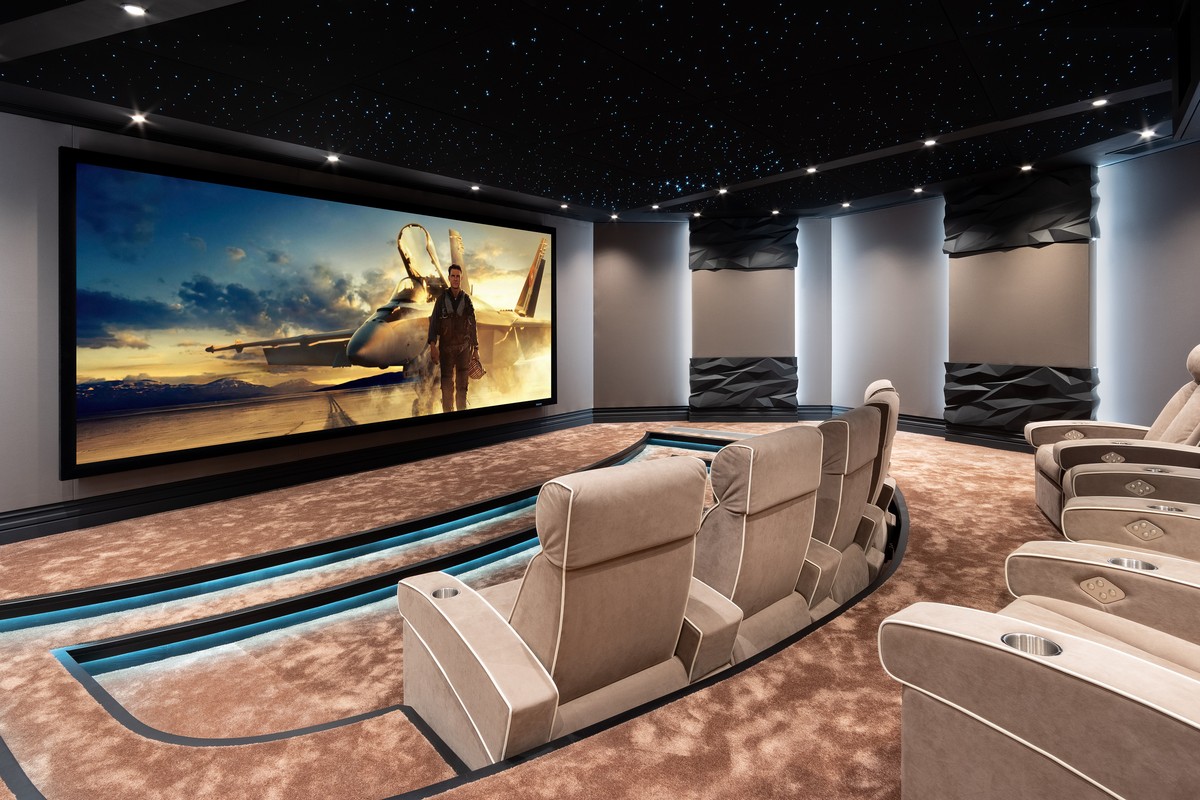
Stingray
Explore the speaker platforms we use on the cinema loudspeakers page, and see how bass is designed for every seat on subwoofers and tactile bass.
Frequently asked questions
What speakers do cinemas use?
Commercial cinemas use large horn-loaded speakers for the screen channels behind a perforated screen, subwoofers at the base of the screen wall and arrays of surround speakers on the side, rear and, for immersive formats, ceiling.
Can I put commercial cinema speakers in a private home cinema?
You can, but speakers designed to throw sound 30 m are rarely the best choice at 4 m. Better results come from high-output speakers designed for the size of your room and calibrated for every seat.
How loud is reference level?
Reference level sets 85 dB at the seat for a −20 dBFS test signal per channel, with peaks up to 105 dB per channel and 115 dB for the LFE channel. Most viewers watch a few decibels below it at home.
What speakers are used in professional mixing stages?
Mixing stages use high-output, low-distortion systems that stay accurate at reference level. Alcons Audio Pro-Ribbon systems, which we install in private home cinemas, are used in leading post-production studios.
What subwoofers do cinemas use?
Commercial cinemas typically place large subwoofers at the base of the screen. In a private room it is more effective to use several subwoofers placed and tuned so bass is even across all seats.