

Home Theater Lighting: Why Direct Light Ruins the Picture and How to Design Lighting Scenes
In a private theater, light either serves the film or works against it. Here is why open fixtures have no place in the room, and how to build lighting scenes that take guests from the welcome to the first frame without a single stray reflection on the screen.

Why direct light has no place in a private theater
Picture the opening of a night scene. A city skyline, a figure in a dark coat, rain glinting on the asphalt. In a properly lit theater the black around them is a void, and the image seems to float in it. Switch on a single wall sconce and that void turns into a gray sheet. The coat dissolves into it. So does the rain.
Contrast is the first casualty
A projector forms the image with light reflected off the screen, and the screen cannot tell projector light from any other light. Every ray from an open lamp, a chandelier or a side sconce lands on the same surface and adds to it. Black is the absence of light, so any extra light raises the floor of the whole image: deep black becomes dirty gray, and the shadow detail the colorist worked on is the first thing to disappear.
Glare pulls you out of the film
In a dark room the eye opens up to catch every nuance of the picture. A bright point in the field of view, whether a spotlight, a sconce or a glowing bezel, cuts straight through that adaptation. You squint, look away, raise a hand to shield your eyes. The moment you notice the light, you are no longer inside the scene. Your eyes also tire faster as they keep switching between a bright point and a dark screen.
Chandeliers and open sconces
A hanging chandelier can physically cut into the projector beam. Classic sconces with open shades throw stray highlights onto the screen, the seat frames and any glossy trim. They look like cinema, and they work against it.
Indirect light: the professional standard
Professional private theaters use reflected light only. The viewer sees the glow, never the source.
Hidden LED lines
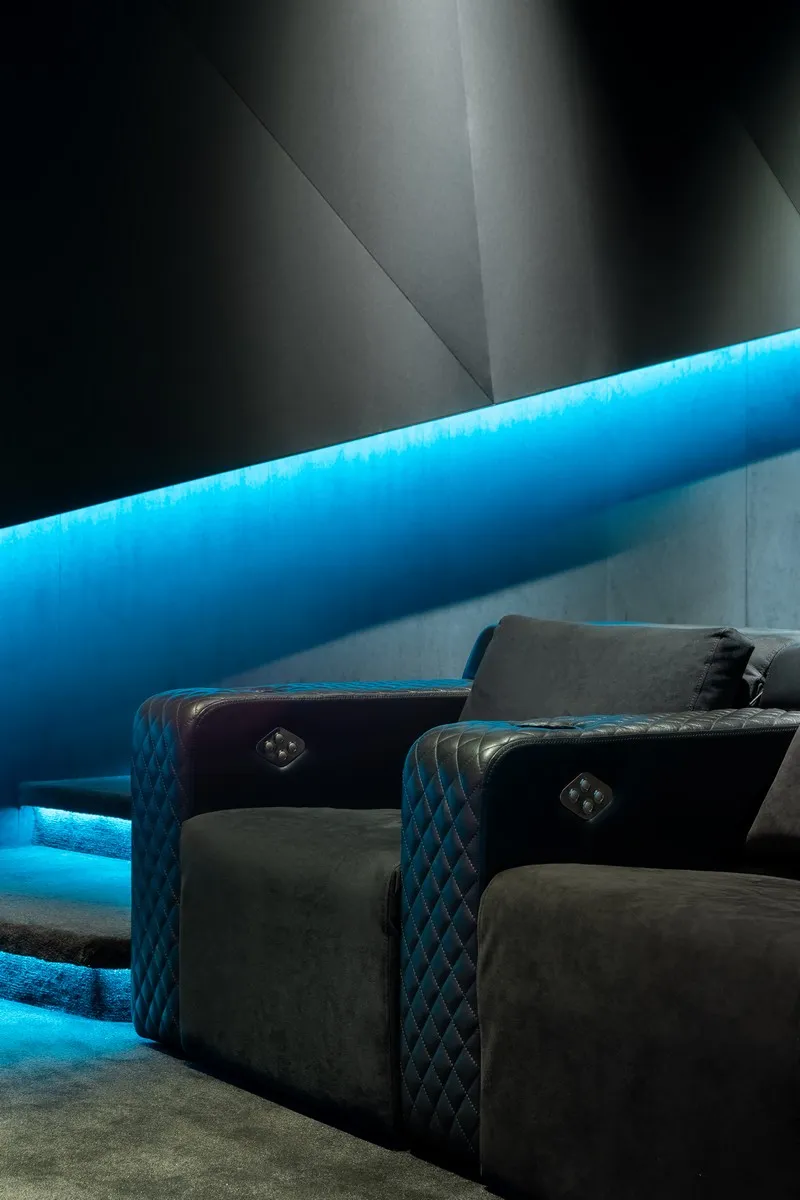
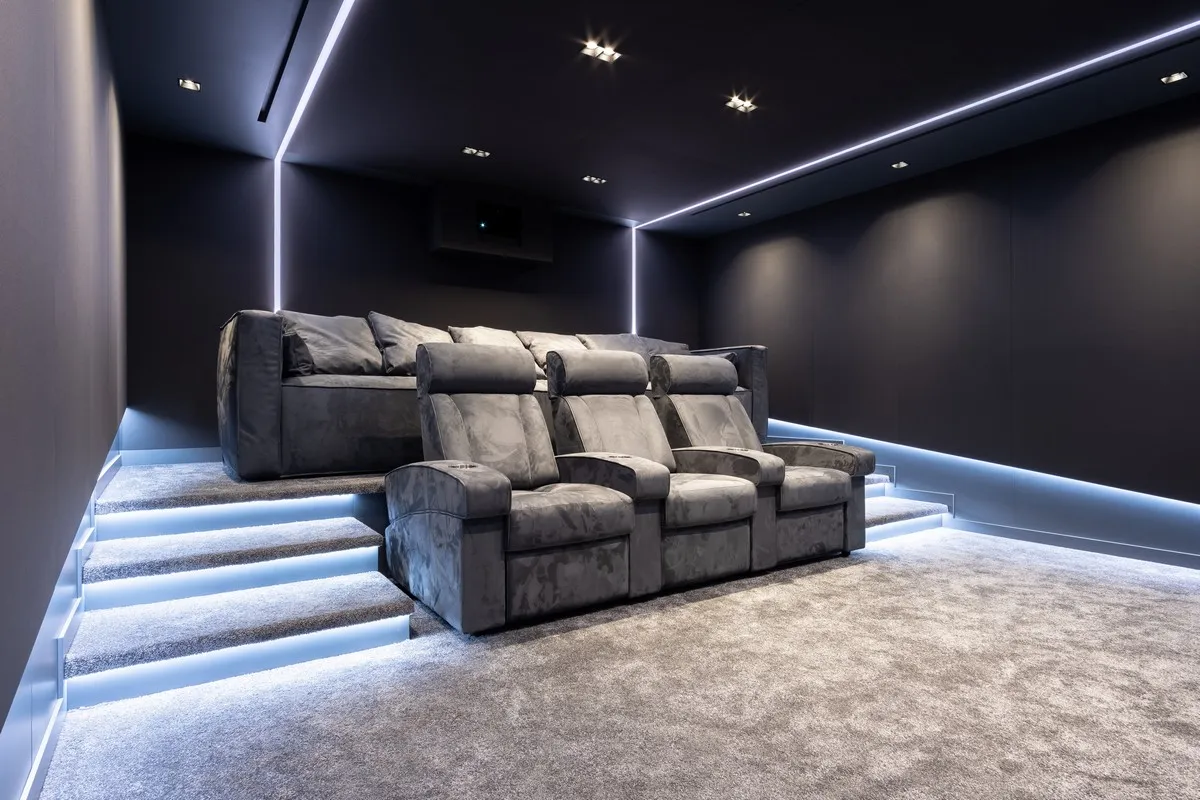
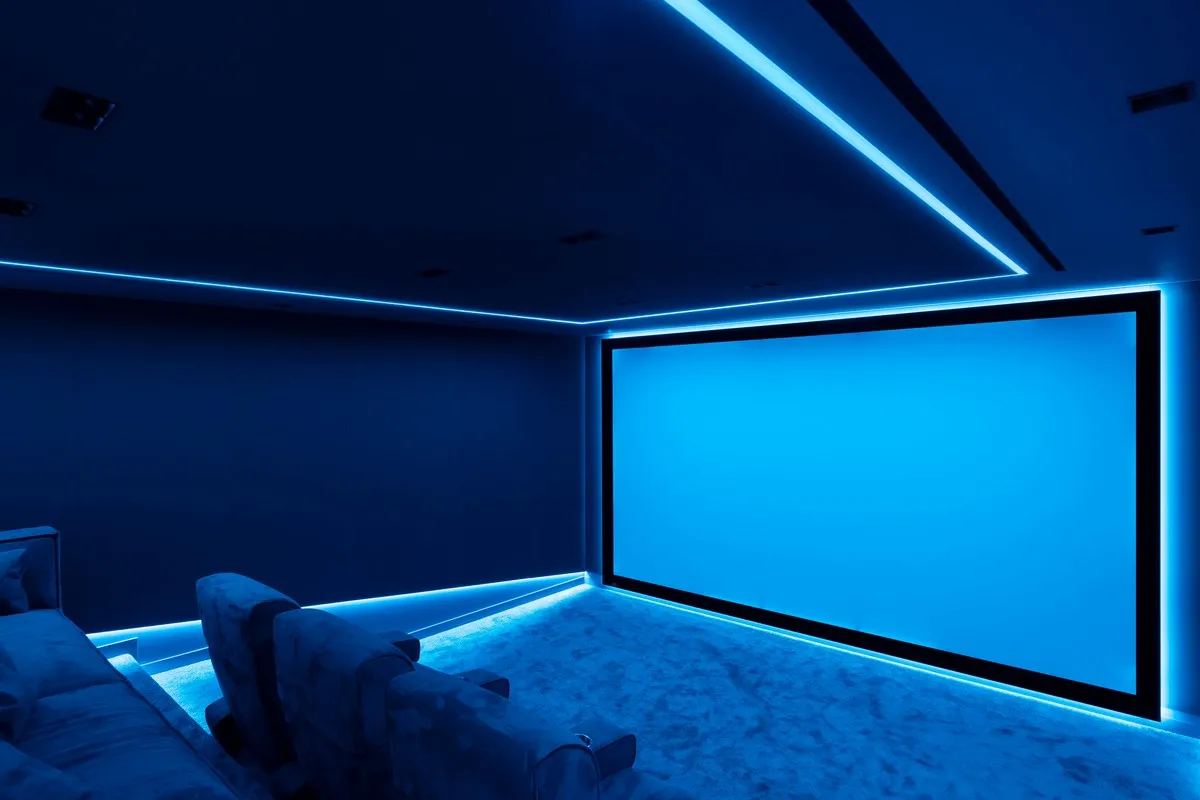
LED strips sit behind profiles, inside ceiling coves and between wall panels. What reaches the eye is a soft wash reflected from a dark matte surface. It traces the architecture of the room without placing a single highlight on the screen.
Deep recessed downlights with honeycomb louvers
When a room needs downlights, the LED module should sit as deep inside the housing as possible. A honeycomb louver in front of it cuts off side spill and sends the beam strictly down or up. Seated guests never look into a bright point, and the screen stays outside the beam.
Working with dark surfaces
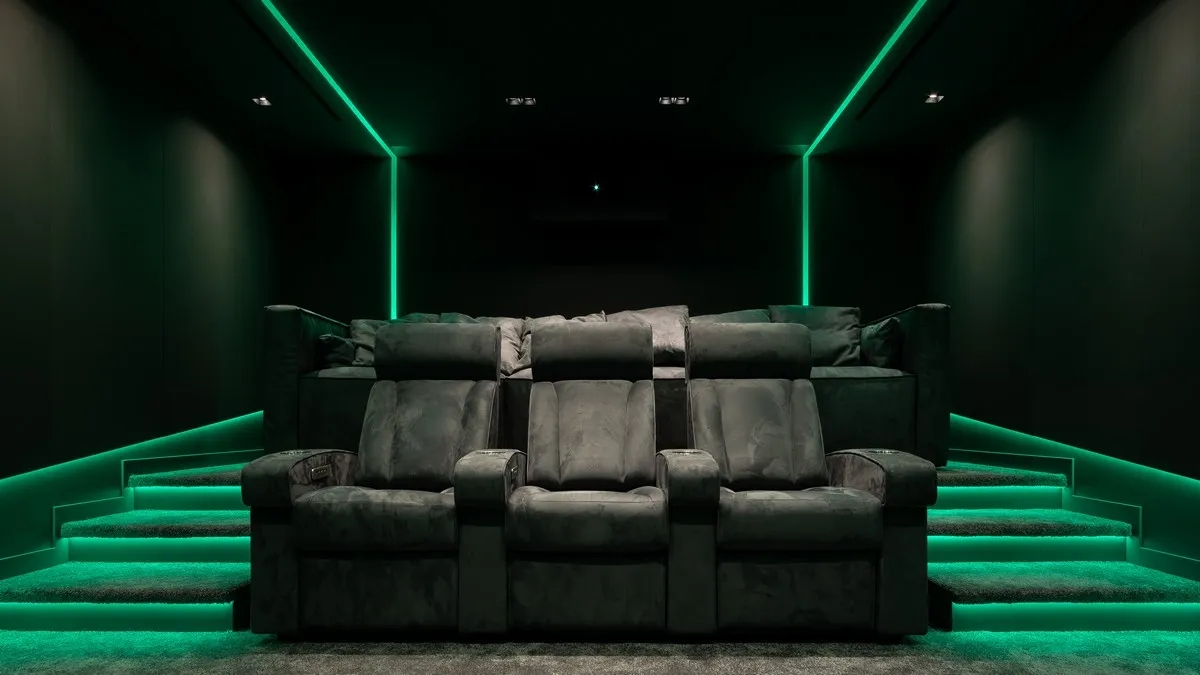
Black velvet, dark carpet and fabric-wrapped walls are what make a theater truly dark, and they reflect almost nothing. That is exactly what you want during the film, and a challenge before it: an ordinary LED line barely registers on them. Installers often double the lines, pairing a powerful white strip with an RGB strip, so the room can take a clean neutral wash or a tint that matches the mood of the evening.
Five lighting scenes every private theater needs
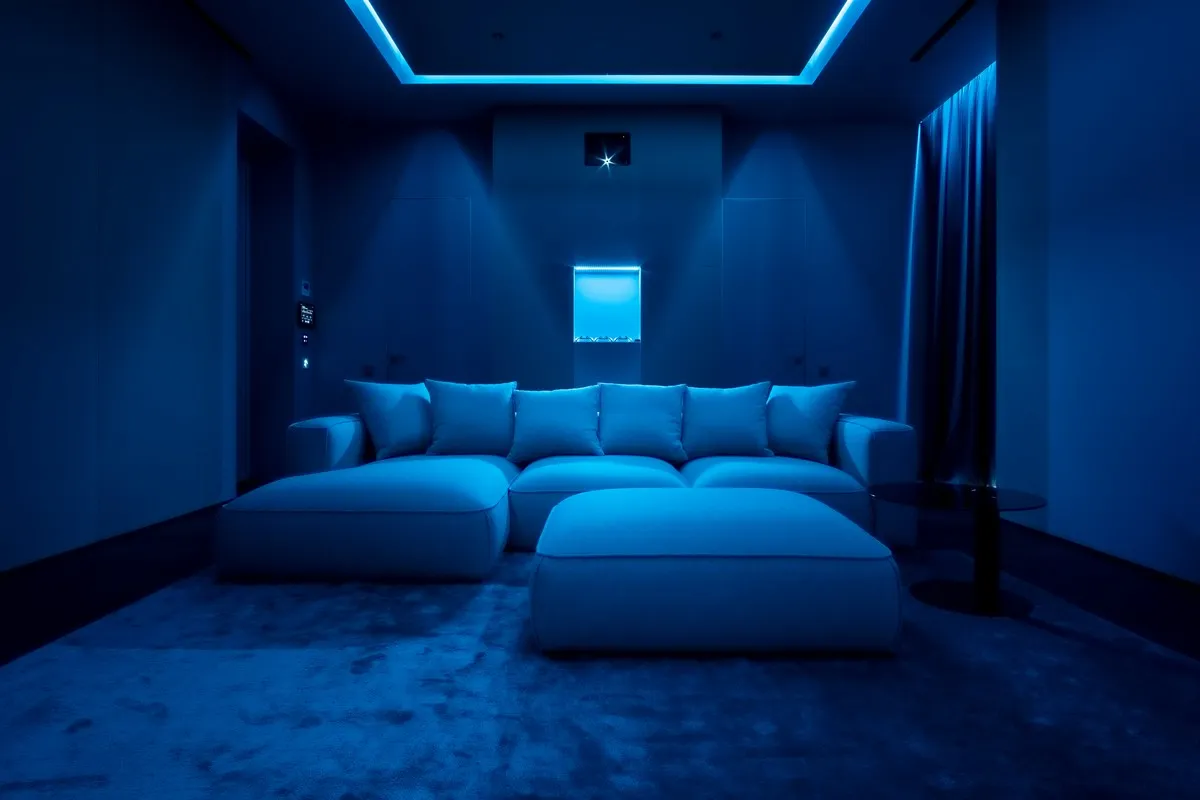
Good lighting design splits the room into independent groups and combines them into presets. These five scenes cover almost everything that happens in a private theater.
Movie mode
The main light, sconces and decorative wall lighting go out completely. Only the step lights on the riser remain, at around 5% of their output. They can glow constantly or come up when the door opens, so a guest returning with a drink finds the steps without throwing light onto the screen.
Service and general light
Every group of recessed downlights and ceiling coves comes on. This is the working scene for cleaning, maintenance and preparing the room. It is bright, practical and never used during a film.
Welcome and presentation
Soft reflected light traces the ceiling coves, the riser and the decor on the walls. The room feels like a private lounge. Guests take their seats in this scene, and from it the theater fades to black when the film begins.
Reveal: the room behind the fabric
In a private theater the speakers, subwoofers and acoustic treatment live behind acoustically transparent fabric. A dedicated group of LEDs behind the fabric reveals all of it at the touch of a button. The walls turn translucent, and guests see the engineering that creates the sound they have just felt in their chest. It is the most theatrical moment of any demonstration, and owners tend to use it every time they show the room to friends.
Relax and the star ceiling
A fiber optic star ceiling creates the shimmer of a night sky. The fibers emit light straight down, with no side spill toward the screen, so the stars can stay on while the film plays.
The star ceiling is the only decorative light that can stay on in movie mode. The fibers point straight down and never reach the screen, so the night sky stays overhead while the black on the screen stays black.
Lighting control: zones, fades and one button
Five to ten independent zones
Layered lighting needs separate circuits: steps and riser, stage, ceiling coves, wall lines, downlights, behind-fabric lighting, star ceiling. A typical private theater ends up with 5 to 10 or more independent groups. Fewer zones mean fewer scenes, and a compromise in each of them.
Soft fades instead of switches
Transitions between scenes should be gradual. A slow fade from welcome to movie mode gives the eyes time to adjust to darkness before the first frame. Cut the lights abruptly and the audience spends the opening minute half blind. Fade them slowly and it feels like the curtain rising in a cinema.
DALI, KNX and a single interface
Theater lighting is built on DALI or KNX. Both make each group individually dimmable and let the theater join the wider smart home system of the villa. Control sits on a single touch panel, such as RTI or Lutron, or on a keypad by the entrance. In a Blackroom theater, light is part of one system: a single button dims the room, brings the screen to life, wakes the processor and starts the film.
How Blackroom designs lighting for a private theater
At Blackroom we design lighting together with acoustics, ventilation and the screen, inside the theater's BIM model in Revit. It is part of a project of more than 150 sheets. Every cove, profile and downlight is placed in the model with precision to a fraction of an inch, so light lines never collide with air ducts, acoustic panels or speaker positions once construction starts.
Light can also carry the concept of a room. For our TRON private theater, the client's brief was simple: "I want space. Surprise me." The answer was custom RGB fixtures built into the walls and ceiling as part of the architecture, so the lighting became the theme of the room for seven guests.
Our Dubai showroom, opening in 2027, is built with open architecture: one scene lights the space behind the acoustic fabric and shows the engineering of the entire room. With more than 60 private theaters and media rooms delivered and six CEDIA Awards Winner titles (2023–2026), we treat light the same way we treat sound and picture: as a system calibrated for a single moment, when the room goes dark and only the film remains.

Frequently asked questions
How bright should home theater lighting be during a movie?
Practically dark. In movie mode only the step lights stay on, at around 5% of their output, placed so their light does not reach the screen. The star ceiling can stay on as well, because its fibers shine straight down.
Can I use recessed lights in a home theater?
Yes, if the LED module is deeply recessed and fitted with a honeycomb louver that cuts off side spill. Downlights belong to the service and welcome scenes and switch off completely when the film starts.
Why are chandeliers and wall sconces a problem in a private theater?
A hanging chandelier can cut into the projector beam, and open sconces throw stray highlights onto the screen and glossy surfaces. Both raise the black level of the image and reduce contrast in dark scenes.
How many lighting zones does a private theater need?
Usually 5 to 10 or more independent groups: steps, riser and stage, ceiling coves, wall lines, downlights, behind-fabric lighting and the star ceiling. Each zone is dimmed separately and combined into scenes.
Which control system works best for theater lighting?
DALI or KNX for the lighting itself, with a single touch panel such as RTI or Lutron, or a keypad by the door. What matters most is independent zones, soft fades between scenes and integration with the rest of the theater, so one button runs the whole room.