JVC Projectors for a Private Theater: Choosing Between the NZ500 and NZ900
JVC projectors light many of our private theaters, and the reason is visible in the first dark scene. Which model belongs in your room is a matter of arithmetic.
The film opens on a night sky. On many projectors that sky is a faint gray sheet with dots on it. On a well-installed JVC in a dark room, the screen edge disappears, the stars hang in black, and for a second you are not sure where the wall ends. That single shot explains why JVC projectors are in so many private theaters, including ours.
The current D-ILA range has four laser models, from the DLA-NZ500 to the flagship DLA-NZ900. Choosing between them is less about features and more about your screen, your room and how much light has to reach your eyes.
Why JVC in a dedicated cinema room
JVC builds its projectors on D-ILA, its own reflective LCoS technology. The panels block light unusually well, which gives very high native contrast without relying on a dynamic iris. In a room with dark walls and ceiling, that contrast is what makes a night scene look like night and gives HDR its depth.
All four current models use native 4K panels and laser light sources. The top two add 8K/e-shiftX pixel shifting. JVC also offers Frame Adapt HDR, its own frame-by-frame HDR tone mapping, so many rooms work well even without an external processor.
The current JVC lineup
Brightness and contrast figures are JVC's published peak values. A calibrated projector delivers less than its peak rating, because calibration trades raw output for accurate color. That is why the choice has to start from the screen, not from the brochure.
Choosing a model starts with brightness math
The light on the screen is easy to estimate. Luminance in nits equals the lumens reaching the screen, multiplied by screen gain, divided by π and by the screen area in square meters.
A 160" 16:9 screen is 3.54 m (11.6 ft) wide and 1.99 m (6.5 ft) high, about 7.06 m² (76 sq ft). If about 2,000 lumens reach it after calibration and the screen gain is 1.0, the image delivers around 90 nits. That is a strong result for HDR in a dark room. Our Grayline cinema, with a 160" acoustically transparent screen, was designed for 89 nits.
Larger screens, darker or acoustically transparent fabrics and a second row further back all push toward the brighter models. A 2.40:1 scope screen with an anamorphic lens changes the math again. This is the calculation we run for every room before we name a model.
Where the projector lives
A projector is a powerful light source with fans. In a silent room you hear it in the quiet scenes unless it is designed into the room. We usually place it in a ventilated, sound-isolated hush box at the back of the room or behind the rear wall, so you hear only the film. In some rooms the projector sits in an adjacent space and projects through a port.
When the room is short, a fold mirror helps. In the Park Fonte media room the JVC is mounted vertically and projects through a 45° mirror, which gave the image the throw distance the room itself could not.
Throw distance, lens shift, hush box ventilation and the cable route are fixed by the room design. Choosing the model after the walls are closed often means a smaller screen or an audible projector.
JVC in our projects
Grayline — CEDIA Awards Finalist 2026
A two-row private theater in 29 m² (312 sq ft) of concrete under a 2.58 m (8.5 ft) ceiling. A JVC DLA-NZ9 sits in a Blackroom hush box and lights a 160" acoustically transparent Screen Excellence screen at 89 nits by calculation, with Dolby Atmos 7.1.4 and four 15-inch subwoofers.
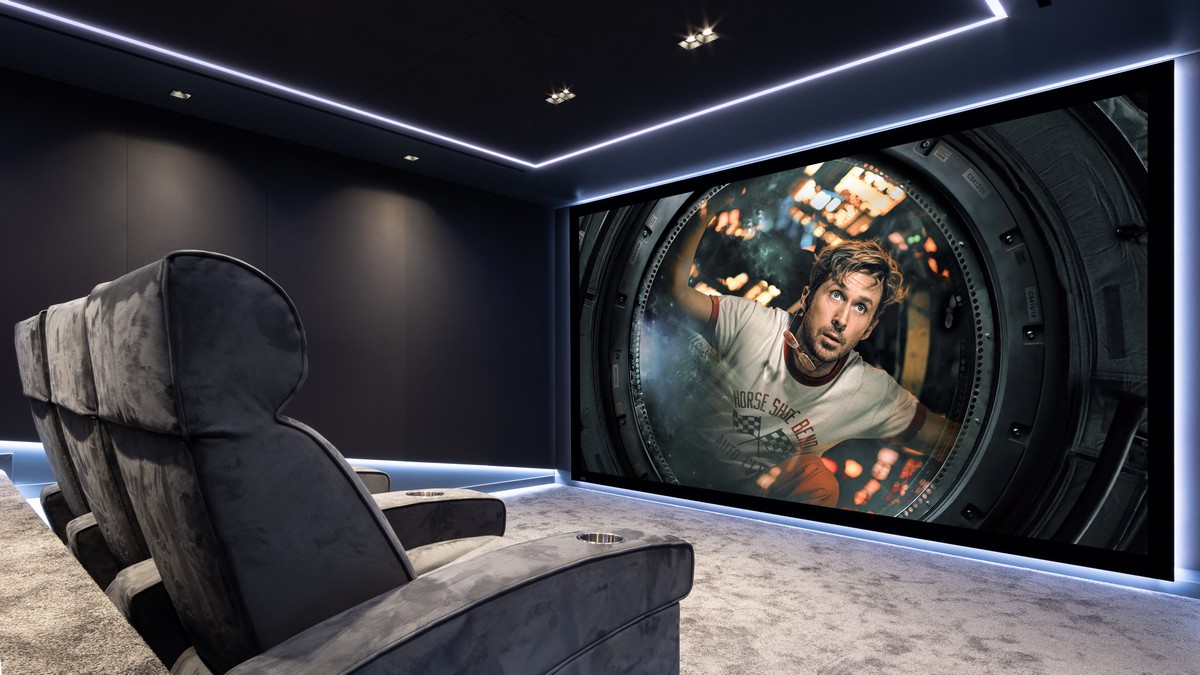
Grayline Cinema
Park Fonte — CEDIA Awards Finalist 2026
A media room on the third floor of a townhouse, with two tall windows, three doors and not enough throw for the screen the owner wanted. A JVC DLA-NZ8 mounted vertically projects through a 45° fold mirror onto a 180" acoustically transparent woven screen.
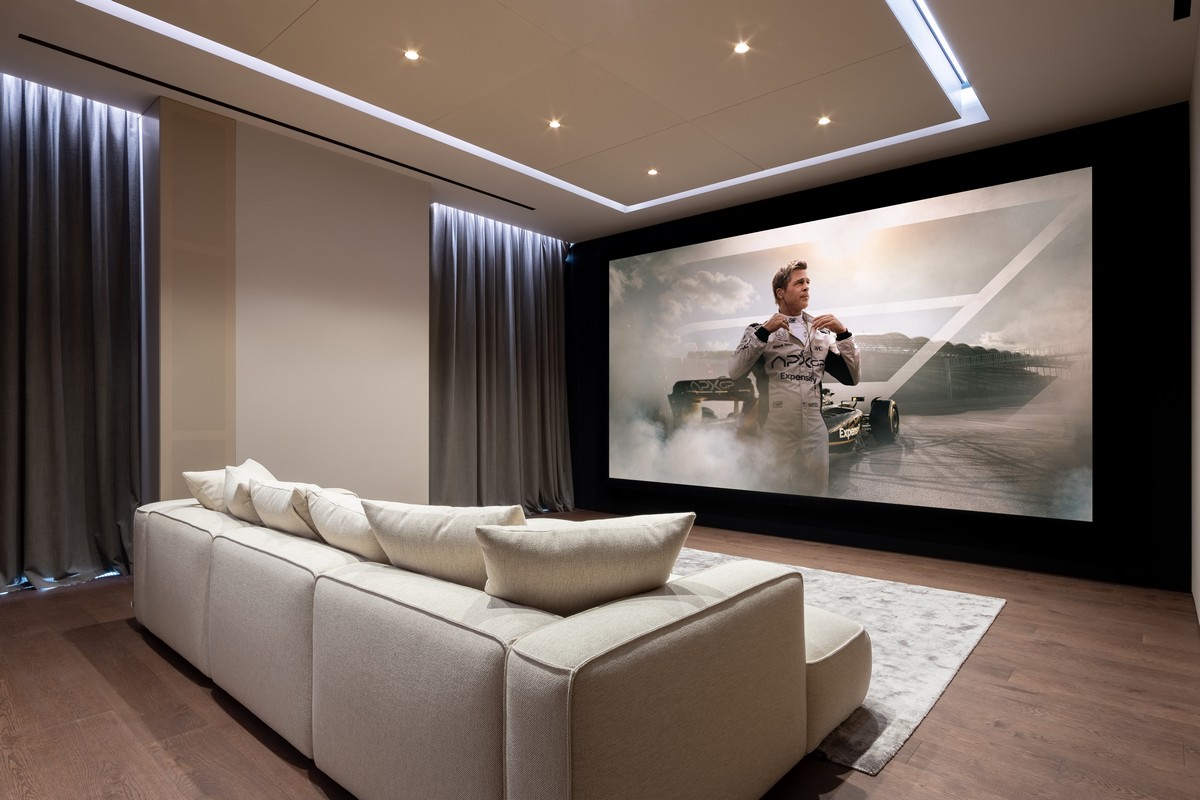
Park Fonte
JVC with an external video processor
Frame Adapt HDR handles tone mapping inside the projector and does it well. In larger rooms, with very bright HDR titles or with a 2.40:1 screen and constantly changing formats, we often add a dedicated processor. Our comparison of madVR Envy and Lumagen Radiance Pro explains when that is worth it. If the 8K label on the NZ800 and NZ900 is part of your decision, read what 8K means on a projector first.
Frequently asked questions
Which JVC projector is best for a private theater?
It depends on screen size, screen material and room. The NZ900 suits the largest screens and darkest rooms, the NZ800 covers many dedicated rooms, and the NZ700 and NZ500 fit smaller screens and media rooms. A brightness calculation for your screen decides.
What is the difference between the JVC NZ800 and NZ900?
The NZ900 is brighter (3,300 vs 2,700 lumens), has higher native contrast (150,000:1 vs 100,000:1) and a larger 100 mm all-glass lens instead of 65 mm. Both use native 4K panels with 8K/e-shiftX.
Are JVC projectors native 4K?
Yes. All four current D-ILA laser models use native 4K panels. The NZ800 and NZ900 add 8K/e-shiftX pixel shifting on top.
How bright should a projector be for HDR?
In a dark private theater, an image of around 80–100 nits gives HDR real impact. The required lumens follow from screen area and gain; on a 160" screen at gain 1.0, about 2,000 calibrated lumens give around 90 nits.
Do I need a hush box for a JVC projector?
In a well-isolated, quiet room, yes in most cases. A ventilated hush box keeps fan noise out of quiet scenes and protects the projector, as long as its airflow is designed with the room's cooling.
Can Blackroom supply and install a JVC projector in Los Angeles?
Yes. We supply JVC projectors as part of a designed private theater in Los Angeles, with the screen, hush box and calibration planned together.